

CARBON I
Utility (petty) knife for vegetables, meat and everyday prep · 73-layer Damascus, cobalt-bearing VG10 core
995,00 kr. incl. tax
The making
CARBON I was designed by Jacob Bech and Shanru Lin, from the first sketch to the finished edge. Every detail was tried, argued over, and tried again. Each of the six knives in EX-ANIMO III has its own finish. That is by design, not by chance. On CARBON I, that finish is a repeated pattern of small triangles pressed into the steel with a die of our own making, etched until you can feel it, and a full-tang handle in carbon fiber.
- The steel73 layers in total, including a cobalt-bearing VG10 steel core; the Damascus layers on both sides are 316L stainless steel.
- The trianglesA repeated pattern of small triangular points is pressed into the blade with a die we make ourselves by EDM. The Damascus layers follow the shape of every triangle.
- Oil quenched and temperedHardened and tempered to 62 HRC. The figure comes from our production testing.
- Deep acid etchingThe layers respond differently to the acid, leaving the triangles as raised and recessed areas you can feel on the flat of the blade.
- The markThe RICEKNIFE name and carbon’s square from the periodic table, C, 6 and 12.011, are engraved directly into the right side by EDM. The RICEKNIFE and LINBECH logos are stamped into the left side.
- The handleCarbon fiber on a full tang: the steel runs the whole length of the handle. Carbon fiber keeps the handle light, holds its shape and absorbs very little moisture, so it needs no oiling.
- Ground by hand, then approvedEvery edge is ground by hand. Jacob examines each finished knife before it is approved. A numbered certificate comes with the knife.
I do not use a large chef’s knife for everything. When I want to divide an apple or chop a handful of herbs, I often reach for something lighter. CARBON I is the knife I made for those moments.

73 layers. One cobalt-bearing VG10 core.
The steel, certified
- IA documented core. We keep the mill certificate for our cobalt-bearing VG10 core and publish its recorded composition, so you can see which steel forms the cutting edge.
- IILayers you can feel. Deep acid etching leaves a relief in the steel itself, not a pattern printed or lasered onto the surface.
- IIIA mark engraved, not lasered. The motif and name are cut by EDM to avoid deforming the blade. It costs more time, labor and electricity.
- IV62 HRC, tested. Oil quenched and tempered; the hardness comes from our production testing, not from the certificate.
- VAn edge ground by hand. Ground by Jacob and his team in the workshop, not on a production line. Every knife examined by Jacob before approval.
The certificate describes the annealed raw bar, 236 HB, and does not certify layer count or finished hardness; the 62 HRC comes from our own testing after heat treatment. No single element makes a knife; the core, the heat treatment and the geometry do.
We are stardust.
On the right side of the blade is carbon’s square from the periodic table: C, 6 and 12.011. Its chemical symbol, its atomic number and its relative atomic mass, engraved directly into the steel by EDM.
There was no carbon when the universe began. Every atom of it was made inside a star, and became part of the material from which Earth formed. The same carbon is in every living thing, in the carbon that helps give this blade’s steel its hardness, in the fiber of the handle, and in the hand that holds the knife. We are stardust, the knife and you alike. The knife and the person are made of the same stuff, and both deserve to be cared for. Care for what you want to keep.
The first release includes 200 CARBON I knives. Each comes with a numbered certificate.

The light utility knife.
The size the Japanese call a petty: for herbs, fruit, vegetables and smaller pieces of boneless meat. A compact blade for the work that does not need a long chef’s knife, made to sit alongside one. It is the smallest and most affordable knife in EX-ANIMO III.
Triangles pressed into the steel.
CARBON I is finished by hand. We make a die with small triangular raised points by EDM, and the die presses the repeated pattern into the blade. Deep acid etching then brings the Damascus layers up around every triangle as a relief you can feel on the flat of the blade, away from the edge. The pattern is visible in the light and changes as you turn the blade.
Carbon’s square, C, 6 and 12.011, and the RICEKNIFE name on the right side are engraved directly into the steel by EDM, no laser. Run a finger over them and you will feel the edges. That is a separate process from the pressed pattern. The RICEKNIFE and LINBECH logos on the left side are stamped into the steel.

Carbon fiber, full tang.
The handle is carbon fiber over a full tang: the blade steel continues through the entire length of the handle, and the carbon fiber scales are fixed to it with three round pins. Carbon fiber keeps the handle light, holds its shape and resists everyday moisture. It absorbs very little, so it needs no oiling; wipe it dry with the blade.
Carbon is also the point of this knife. It is in the fiber of the handle, in the carbon that helps the steel develop hardness during heat treatment, and in the hand that holds it. At 105 g, the whole knife is light enough to reach for without thinking, for an apple, a handful of herbs or the small jobs between meals.
About the edge
Warning: this knife arrives sharper than most people expect. Unpack it with care and keep it away from children.
The core is a cobalt-bearing VG10 steel, oil quenched and tempered to 62 HRC, then hand sharpened on stones by Jacob and his team in the workshop. In the film above, at the very end, he tests it the way we test every knife: a sheet of printer paper, no pressure, one clean cut.
Cut on wood or suitable plastic, never on glass, stone or metal. No bones, no frozen food, no twisting in the cut. Wash by hand and dry straight away.
In detail
- Type
- Damascus petty utility knife, full-tang carbon fiber handle
- Blade
- 15 cm. Blade height 30 mm at the heel. Overall 257 mm, handle 107 mm
- Weight
- 105 g (knife only); shipping weight 0.3 kg with packaging
- Steel
- 73 layers in total, including a cobalt-bearing VG10 steel core; the Damascus layers on both sides are 316L stainless steel
- Core
- Cobalt-bearing VG10 steel: C 1.10 · Cr 14.56 · Mo 0.84 · Co 1.54 · V 0.25 · W 0.11%
- Hardness
- 62 HRC after tempering, oil quenched
- Making
- Finished by hand
- Surface
- Repeated triangular pattern pressed into the blade with a die made by EDM, brought out in relief by deep acid etching
- Right side
- RICEKNIFE and the periodic-table symbol for carbon, C, 6 and 12.011, engraved directly by EDM
- Left side
- RICEKNIFE and LINBECH logos stamped into the steel
- Handle
- Carbon fiber, full tang
- Edge
- Ground by hand
- Edition
- First release of 200. Numbered certificate included. Further production possible
- Gift
- Engraving and gift wrapping on request
- Collection
- EX-ANIMO III 2026
Designed in Denmark by RICEKNIFE. The cobalt-bearing VG10 core is documented by a mill certificate we keep. Read about the steel
Buy
995,00 kr. incl. tax
- Limited edition. First release of 200, numbered certificate included.
- Ground and finished by hand. Jacob examines every knife before approval.
- Engraving and gift wrapping on request.
Ask JacobAsk Jacob anything: a knife, a stone, a gift, or your own sharpening. We do our best to be here around the clock and to reply within the hour during the day, Copenhagen time, or first thing next morning if you write at night.
WhatsApp +45 20 46 46 90 · Instagram @riceknife_denmark · [email protected]
We keep evolving.
EX-ANIMO III is the third generation of the series, and every generation has been a step on from the last. EX-ANIMO III has a cobalt-bearing VG10 core with a mill certificate we can show you, a motif and name engraved by EDM instead of laser, a deeper etch you can feel, and an edge ground by hand by Jacob and his team. We do not release a new series until we are sure it is a step forward. This is the best we have made so far, and the next one will have to beat it.
The collection


VALKYRIE III
The longer, lighter chef’s knife. 23.7 cm, 204 g, long Damascus lines and runes cut into the steel.


Knife care
Keep it this sharp
A knife this sharp stays sharp only if you maintain it. Jacob spent five years on the sharpening system below, and made a video for each set. Start with the set that matches how often you cook, not how good you think you are.

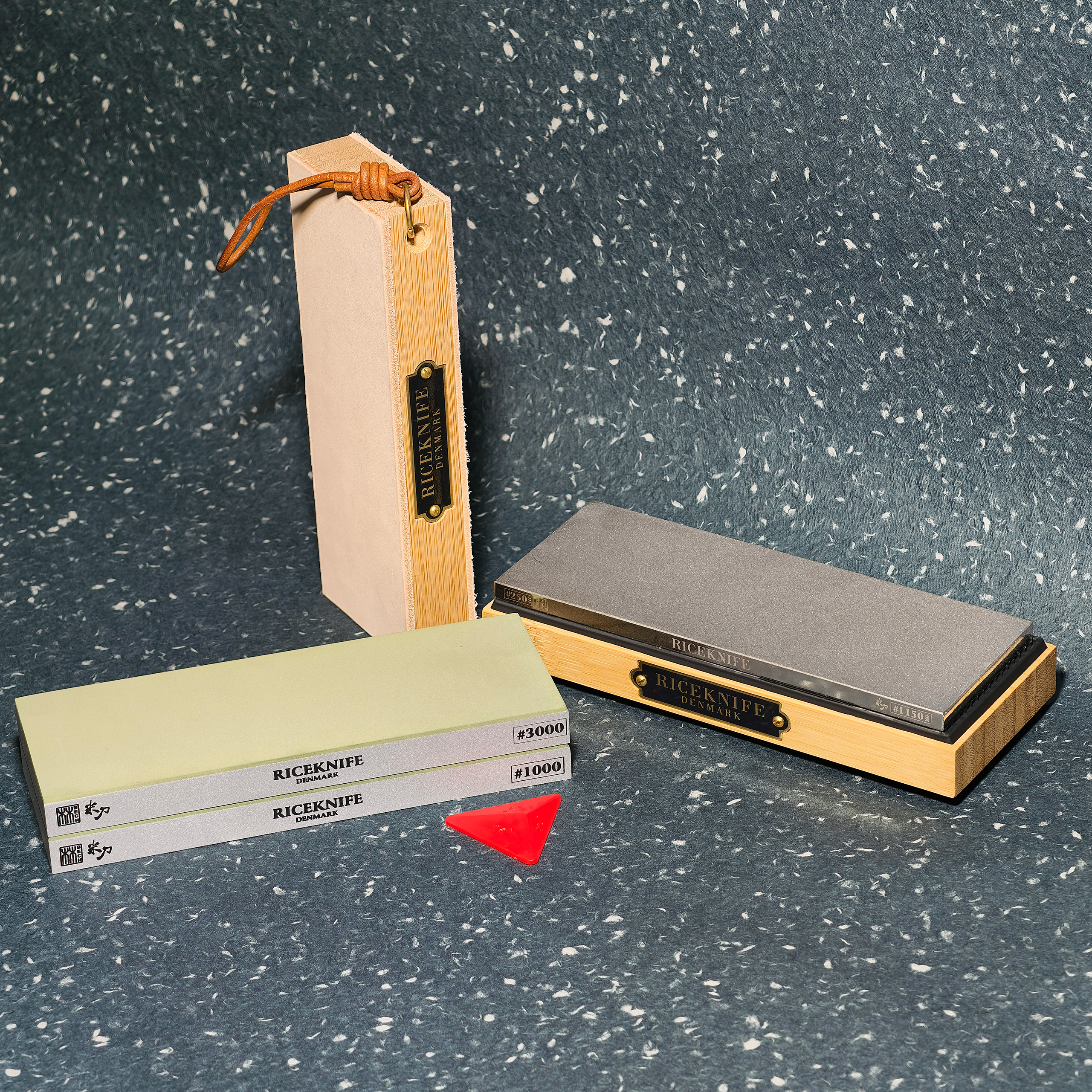

The full system, Jacob’s story and all the videos: Jacob’s Sharpening
Questions
Is CARBON I a petty knife?
Yes. Petty is the Japanese name for a small utility knife, usually between 12 and 15 cm. CARBON I is a 15 cm petty in Riceknife’s own design, with a cobalt-bearing VG10 core and a full-tang carbon fiber handle, finished by hand. Use it for herbs, fruit, vegetables and smaller pieces of boneless meat: the jobs where a long chef’s knife feels unnecessarily large.
What do C, 6 and 12.011 on the blade mean?
They are carbon’s square from the periodic table: its chemical symbol, atomic number and relative atomic mass, engraved directly into the right side of the blade by EDM. The knife is named for what it is made of. The handle is carbon fiber, the edge owes its hardness to the carbon in the steel, and every atom of carbon in the universe was made inside a star, so the knife, and the person holding it, are made of the same stardust. The certificate that comes with the knife says exactly that.
Is CARBON I a good gift?
Yes, for a new home or for someone who already has a chef’s knife. CARBON I is a 15 cm, 105 g Damascus petty utility knife with a carbon fiber handle and the periodic-table symbol for carbon engraved into the blade. It is the knife to give for a housewarming, a first apartment, a graduation, a first job, or as a Christmas gift that stays within a budget: the most affordable knife in EX-ANIMO III, and small enough that someone who owns a good chef’s knife will still use it every day. First release of 200, numbered certificate.
Who is CARBON I for?
Someone moving into their first home, a graduate, a new colleague, a host, a parent who cooks small meals, someone who loves the night sky or works in science, or anyone you want to give a real knife without giving a large one. At 105 g and 15 cm, it is the knife for the small jobs between meals.
Can CARBON I be engraved or gift wrapped?
Yes. We can engrave a name, a date or a short line, and we can gift wrap the knife. Message Jacob on WhatsApp (+45 20 46 46 90) or Instagram (@riceknife_denmark), or email [email protected], when you order, to agree the text and the wrapping. He will tell you what can be engraved and how long it adds to dispatch.
How does CARBON I differ from AMOR II?
Both have a full-tang handle and a repeated pattern pressed into the steel with a die and brought out by deep acid etching. CARBON I is the small one: a 15 cm petty utility knife with a carbon fiber handle and the periodic-table symbol for carbon in the steel; it weighs 105 g. AMOR II is a 23 cm chef’s knife with a heart pattern and a red and black G10 handle; it weighs 242 g. If you want a light knife for fruit, herbs and the small jobs, or a knife for someone who already has a chef’s knife, choose CARBON I; for the main knife at the board, choose AMOR II.
Why does CARBON I cost more than an ordinary VG10 Damascus knife?
The steel: not every steel sold as VG10 is the same, and ours is a cobalt-bearing VG10 that comes with a mill certificate, and we publish the figures on it. It is oil quenched and tempered to 62 HRC, and the edge is still ground by hand. The surface: the triangles are pressed into the blade with a die we make ourselves and then deep etched, so you feel a real relief under your fingertips, not a printed or lasered pattern. The finish: the carbon symbol and the name are engraved by EDM, every edge is ground by hand, and every knife is examined before it is approved.
Is CARBON I laser engraved?
CARBON I is finished by hand. The periodic-table symbol for carbon and the RICEKNIFE name are engraved directly into the blade by EDM, not laser. The RICEKNIFE and LINBECH logos on the left side are stamped into the steel. The repeated triangle pattern is pressed into the blade with a die made by EDM and brought out by deep acid etching.
Is the VG10 in EX-ANIMO III standard VG10?
It is a cobalt-bearing VG10 steel, and it comes with a mill certificate that we keep. The certificate lists the core steel as C 1.10 %, Cr 14.56 %, Mo 0.84 %, Co 1.54 %, V 0.25 % and W 0.11 %. We publish these figures so you can compare them with any other knife yourself; we do not claim they are better than the standard.
Looking for a Japanese VG10 Damascus petty knife?
CARBON I gives you what people look for in a VG10 Damascus petty knife: a 15 cm blade with a cobalt-bearing VG10 core at 62 HRC, 73-layer Damascus and a hand-ground edge, with a full-tang carbon fiber handle. It is designed in Denmark by RICEKNIFE, not made in Japan.
Is CARBON I a luxury knife? What makes it collectible?
A first release of 200, a numbered certificate with every knife, a triangle pattern pressed into the steel and the carbon symbol engraved by EDM rather than printed on it, a hand-ground edge and a documented cobalt-bearing VG10 core. We call it functional art for the kitchen.
Would you prefer a quieter Scandinavian knife set?
For a more affordable set with a quieter Scandinavian expression, see the Raw Oak six-knife set.
How do I sharpen it?
On diamond stones, following Jacob’s videos. We sell three sharpening sets, each with its own video: Beginner, Chef and Professional. Start with the set that matches how often you cook, not how good you think you are.
How do I care for the blade and the carbon fiber handle?
Wash by hand and dry after use. No soaking, no dishwasher. Wood or suitable plastic board. No bones, frozen food or twisting. Carbon fiber absorbs very little moisture and needs no oiling; wipe it dry with the blade, and protect the edge in storage. Sharpen as needed on diamond stones; see Jacob’s videos.
Still have a question? Ask Jacob on WhatsApp. We usually reply within the hour during the day, Copenhagen time.