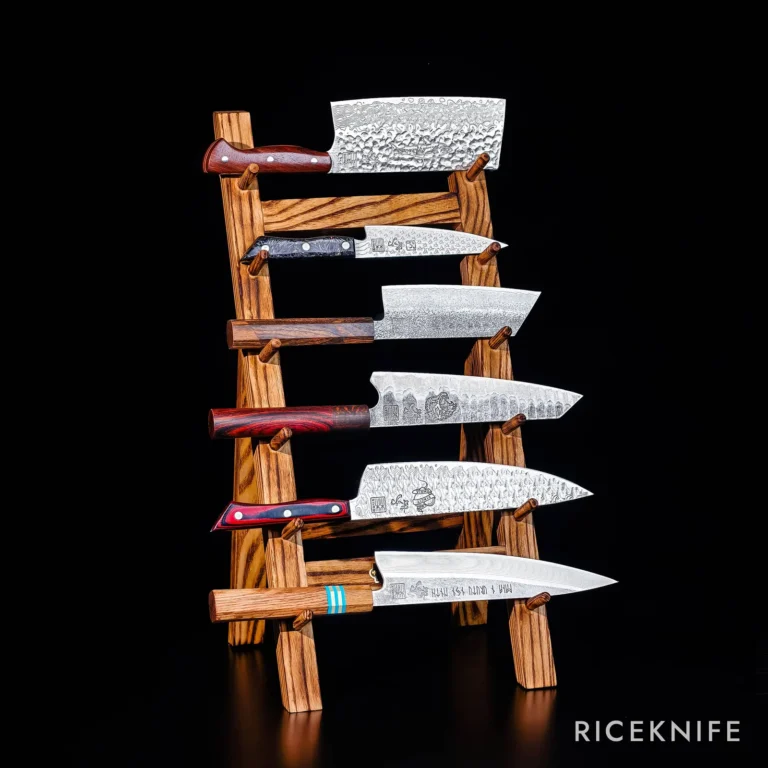
Short answer: Yes, Damascus kitchen knives can be very good, but the pattern alone does not make a knife sharper or better at cutting. What matters most is the steel at the cutting edge, its heat treatment and hardness, the blade geometry and the sharpening. In clad Damascus kitchen knives, the patterned outer layers surround a separate cutting core, and the pattern is mainly cosmetic.
That does not make the pattern meaningless. A well-made knife can be a precise tool and something you enjoy looking at. The point is to know what you are paying for.
What Is a Damascus Knife?
In modern kitchen knives, “Damascus” usually means pattern-welded steel: layers of different steels are forge-welded together to create a patterned material. Etching is commonly used to make the pattern more visible. (Historical wootz Damascus is a different material: a single steel whose pattern comes from its microstructure.)
There are two constructions to tell apart:
- Clad Damascus: patterned outer layers surround a separate core steel, and only the core forms the cutting edge. This construction is common in modern Damascus kitchen knives.
- Edge-forming Damascus: the patterned steel itself runs through the cutting edge, so the steels and the way the layers are arranged can affect how it cuts.
| Factor | What it tells you |
|---|---|
| Damascus pattern | Mainly appearance, in a clad knife |
| Core steel | Which steel forms the cutting edge |
| Hardness (HRC) | How hard the edge steel is, not overall quality |
| Heat treatment | Influences hardness, toughness and other steel properties |
| Blade geometry | How easily the blade moves through food |
| Layer count | Describes the construction, not performance |
Pros of Damascus Knives
1. The Cutting Steel Matters More Than the Pattern
In a clad Damascus knife, the core steel forms the edge. The steel’s composition, heat treatment and hardness, together with the edge geometry and sharpening, influence how sharp the knife can become and how well it holds its edge. RICEKNIFE’s EX-ANIMO III Damascus kitchen knives, for example, have a VG10 core hardened to 62.5 HRC, clad in 316L stainless steel, 73 layers in total. These are useful specifications, but the pattern itself is not proof of a better edge. When you compare knives, look past the layer count to the core steel, hardness and blade geometry.
2. Looks
Many cooks choose Damascus because they enjoy using a knife that also looks good. The layered pattern gives each blade a distinctive look, as on the TIGRITUDE III EX-ANIMO III Damascus kiritsuke knife. That is a fair reason to buy one, as long as you know you are paying partly for the look.
3. Cladding and the Cutting Core Have Different Roles
In a clad Damascus blade, the outer layers form the sides of the blade around a separate cutting core, and the core forms the edge. Whether that combination suits a given kitchen task depends on the steels, the heat treatment and the blade geometry. Cladding alone does not guarantee greater toughness: in pattern-welded steels tested by Knife Steel Nerds in 2023, toughness was “largely controlled by the less tough of the two steels” (source). That test did not cover a separate VG10 core with 316L cladding, so it is context, not a verdict on any one knife. A hard, thin edge can still chip on bone or frozen food.
4. Worth Keeping for Many Years
A well-made Damascus knife can be worth keeping for many years, but how long it lasts depends on its construction, use and care, not on the pattern. Appropriate use, careful cleaning and sharpening when needed matter more than the number of layers.
Cons of Damascus Knives
1. Care Depends on the Steel
Care depends on the steels used, both the cutting core and any exposed outer layers. Corrosion-prone steels, such as carbon steel, can rust when left wet and may benefit from occasional protective oiling. Stainless Damascus, such as a VG10 core with 316L cladding, is far less demanding, but stainless resists rust; it is not rust-proof. Wash it by hand with warm water and a little soap, dry it right away, and never put it in the dishwasher. Read more in the complete guide to buying and caring for Damascus steel kitchen knives.
2. Cost
Patterned Damascus construction can involve extra manufacturing work, which may raise the price compared with a plain blade using a similar cutting steel. A higher price does not guarantee better cutting. Decide whether the look is worth the difference to you.
3. The Pattern Is Mostly Cosmetic
Jacob Bech, RICEKNIFE’s founder, a chef and knife maker, said in 2024: “the Damascus pattern is first and foremost cosmetic” (translated from Danish). In a clad knife the patterned layers do not form the edge, so the pattern gives no sharpness advantage. A plain blade with comparable cutting steel, heat treatment, blade geometry and sharpening can cut just as well. Even knives made from similar steel can feel different in use when their thickness, grind or edge finish differs. More on this in how to choose a Damascus knife set.
Are Damascus Knives Worth Buying?
Pros:
- Core steel: a good core steel, well heat-treated and ground, matters more than the pattern.
- Construction: in clad Damascus knives, patterned outer layers surround a separate cutting core.
- Looks: the pattern gives the blade a distinctive appearance.
- Long-term ownership: with good use, care and sharpening, a well-made knife serves for many years.
Cons:
- Care: carbon-steel layers need extra care; stainless resists rust but is not rust-proof. Hand wash, dry right away, no dishwasher.
- Cost: can be more than a plain blade using a similar cutting steel.
- Mostly cosmetic pattern: in a clad knife the pattern does not improve cutting.
Final verdict: Buy a Damascus knife because you value both its look and the way it is made, not because the pattern promises better cutting. Check the cutting steel, heat treatment and blade geometry first, and be ready to wash and dry it by hand. If the look matters less to you, a plain blade with comparable specifications may cut just as well for less. See all RICEKNIFE kitchen knives, Damascus and RAW OAK.
Frequently Asked Questions
Do Damascus knives rust?
Yes, some do. Rust resistance depends on the steels in the blade, not on the Damascus pattern. Corrosion-prone steels, such as carbon steel, need careful drying and may benefit from occasional protective oiling. Stainless Damascus, such as RICEKNIFE’s EX-ANIMO III with a VG10 core and 316L stainless cladding, resists rust but is not rust-proof. Wash it by hand, dry it right away and keep it out of the dishwasher.
Is the Damascus pattern only cosmetic?
In a clad Damascus kitchen knife, mostly yes. The patterned outer layers do not form the edge, so the pattern does not make the knife sharper. RICEKNIFE founder Jacob Bech said in 2024 that “the Damascus pattern is first and foremost cosmetic” (translated from Danish). Edge-forming Damascus is different: in Knife Steel Nerds’ 2023 CATRA tests, ladder patterns, with layers crossing the edge, gave better slicing edge retention than straight layers in the steel combinations tested. That finding concerns the tested edge-forming constructions and does not establish a slicing edge-retention advantage for clad knives such as EX-ANIMO III.
What makes a Damascus knife good?
The same things that make any kitchen knife good: the steel at the edge, its heat treatment and hardness, the blade geometry and the sharpening. A named core steel and a stated HRC are useful, but neither guarantees performance. RICEKNIFE’s EX-ANIMO III, for example, has a VG10 core at 62.5 HRC, clad in 316L stainless steel, 73 layers in total. Then choose a blade shape, pattern and handle you like.