Choosing a Damascus knife set you will actually use
Buy a set for the jobs its knives do, not for the pattern on the blades. On a modern Damascus kitchen knife the pattern is cladding; the edge is ground into a hard steel core. Jacob Bech, who designed the knives with Shanru Lin, put it plainly in 2024: the Damascus pattern is first and foremost cosmetic.
The EX-ANIMO III set is described in RICEKNIFE’s own product records as “six knife types for small, precise and long cuts”, all with a VG10 core specified at 62.5 HRC and 316L stainless cladding. The set is intended for cooks who regularly prepare vegetables, fish and boneless meat and want different knives for small, precise and long cuts. It does not include a bread knife or a knife stand, and none of its knives is for bones or frozen food.
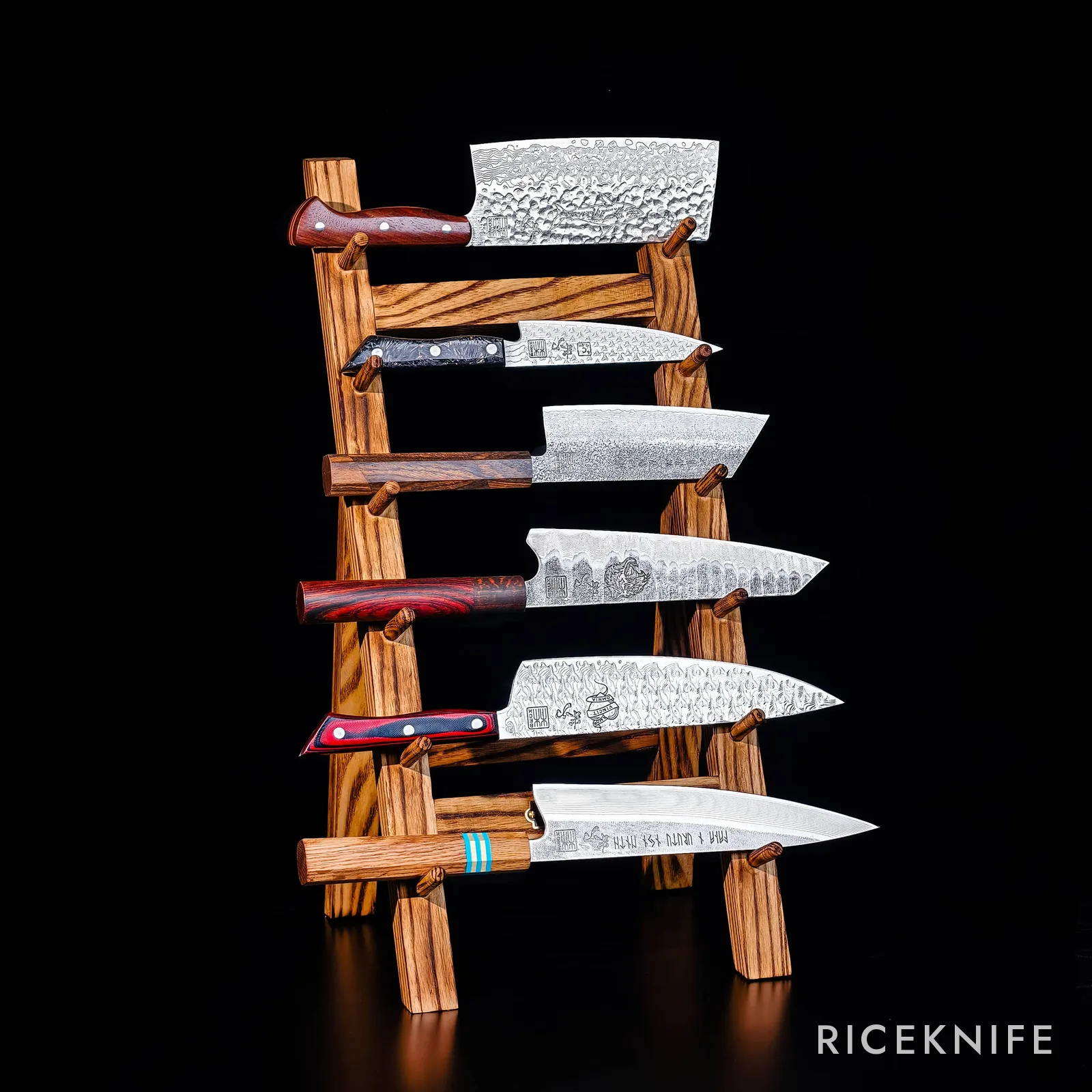
Photo: the six knives of the EX-ANIMO III set. The stand in the photo is not included.
By Jacob Bech and Shanru Lin · RICEKNIFE
- What “Damascus” means on a kitchen knife today
- The core steel and what hardness can and cannot tell you
- Hardness and toughness: why some foods are off limits
- How the designers divided the work between six knives
- Worked example: what blade height and edge angle change
- Set or single knives: a decision framework
- What we cannot tell you yet
- Questions buyers ask
- Sources
What “Damascus” means on a kitchen knife today
The word “Damascus” covers both historical wootz steel and modern pattern-welded steel.
Wootz Damascus was a crucible steel with about 1.5% carbon. In historical wootz steel, the visible pattern is associated with carbide-rich bands that developed within the steel during processing [1]. Pattern-welded Damascus is made by forge-welding alternating sheets of high- and low-carbon steel, then folding and welding again until there are many layers. Verhoeven, Pendray and Dauksch describe both types in their study of historical blades [1].
Modern Damascus kitchen knives belong to the second family, usually in a clad construction:
- Core
- A hard blade steel in the centre. The cutting edge is ground into this layer.
- Cladding
- Layers of a different steel bonded to both sides of the core. Etching makes the layers visible as the pattern.
Takefu Special Steel, the Japanese mill that developed VG10, describes multi-layer clad material in the same way: several metals clad alternately in repeated layers, giving a pattern that differs from knife to knife [2].
For a shorter overview of the material itself, see The Truth About Damascus Steel.
The pattern shows how the cladding was layered. The pattern alone does not establish how well the knife cuts. That depends on the core steel, its heat treatment, the edge geometry and the shape of the blade. EX-ANIMO III blades have 73 layers in total: a VG10 core with 316L stainless steel on both sides.
316L is a low-carbon austenitic stainless steel with molybdenum. Its producer Aperam lists typical values of 0.025% carbon, 18.20% chromium, 10.10% nickel and 2.10% molybdenum, and describes very good corrosion resistance in acidic and chloride-containing environments [7]. Kitchen knives meet salt and acidic foods such as lemon juice and tomato, and the cladding forms most of the blade’s broad faces. Aperam’s description applies to the steel grade; it is not a corrosion test of the finished EX-ANIMO III blade, whose behaviour also depends on how long food and water stay on it and how it is cared for.
We found no primary source linking layer count to cutting performance. A higher number does not make the edge sharper. Jacob makes the same point in his own article on whether Damascus knives are good (in Danish): the pattern is first and foremost cosmetic.
“Damascus mønsteret er først og fremmest kosmetisk.” (The Damascus pattern is first and foremost cosmetic.)Jacob Bech, riceknife.dk, 8 November 2024
The core steel and what hardness can and cannot tell you
RICEKNIFE specifies 62.5 HRC for every EX-ANIMO III knife. That is the company’s confirmed specification, not an independent laboratory measurement.
Takefu gives the representative composition of VG10 as 1.00% carbon, 15.00% chromium, 1.00% molybdenum, 0.25% vanadium and 1.55% cobalt, with a hardness of HRC 60 or more [3]. According to Takefu, chromium, molybdenum and cobalt strengthen the matrix, the continuous steel that holds everything else; vanadium refines the microstructure; and chromium, molybdenum and vanadium form hard carbides that improve wear resistance [3]. These are properties of the steel grade, not a prediction of how a finished knife performs.
Hardness is resistance to permanent indentation, measured on the Rockwell C scale (HRC).
What does hardness buy you? Zhang and colleagues tested blades made from seven martensitic steels using the CATRA method of ISO 8442-5, cutting packs of test card [4][6]. In their test, cutting depth varied with both hardness and blade angle, but hardness alone did not explain the results; the authors discuss the complex wear behaviour of steels containing several phases [4]. These findings describe the tested blades, not a performance prediction for EX-ANIMO III. The steels they tested measured 53.2 to 62.4 HRC, and none of them was VG10 in a clad blade, so their results do not establish how EX-ANIMO III performs. Hardness helps an edge resist deformation and wear. It is one variable among several, and it cannot be turned into a promise about how long these knives stay sharp.
Hardness and toughness: why some foods are off limits
The rule printed for every knife in the set: not for bones or frozen food.
Toughness is a material’s ability to absorb energy before it cracks. In many hardened steels, increasing hardness can reduce toughness, although the relationship depends on composition and microstructure. Zhang and colleagues explain that further hardening may make the very apex of the edge break away for lack of toughness, and that a very small blade angle weakens the edge [4].
That is the reasoning behind the rule. The risk is the same for any thin, hard edge:
- A fine edge has very little steel near its apex.
- Bone and frozen food do not give way the way a carrot or a chicken breast does.
- Striking them concentrates the load on a small part of that thin apex.
- A thin edge may be more vulnerable to impact damage than an edge specifically designed for heavy chopping. Under sufficient load, the edge may chip. The actual risk depends on the steel, heat treatment, edge geometry and applied load; it has not been measured for these knives.
The hardness figure alone does not tell you how resistant these particular knives are to chipping; that has not been tested. It explains why the rule exists. If you need to cut through bone, choose a tool explicitly designed and sold for that use, and follow its manufacturer’s instructions. A knife’s name or blade shape alone does not establish that it is suitable for bone.
Boards follow the same logic. Glass, stone and ceramic surfaces are unforgiving and can damage a fine edge quickly. Use wood or a suitable polymer board.
For everyday care, see our guide to buying and caring for Damascus kitchen knives.
Research on steel laminates has shown that ductile interlayers can stop a crack growing through harder steel [5]. That is a general reason for layered construction. It has not been tested for EX-ANIMO III, and it cannot protect the apex itself, which is bare core steel.
How the designers divided the work between six knives
RICEKNIFE’s own product records describe the set as “six knife types for small, precise and long cuts” and give each knife a job. Read together, they show how the set is meant to be used.
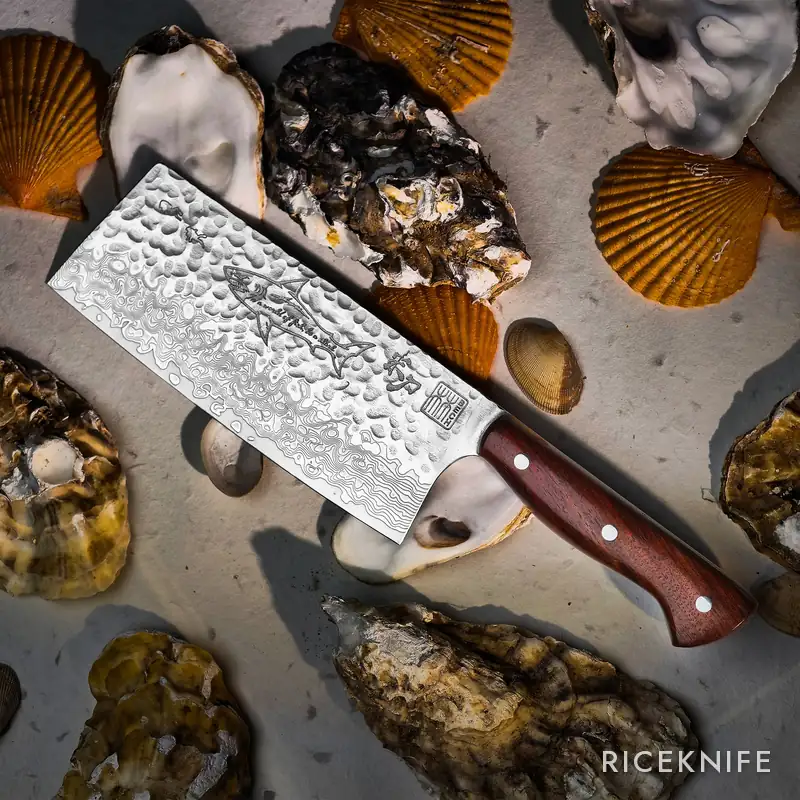
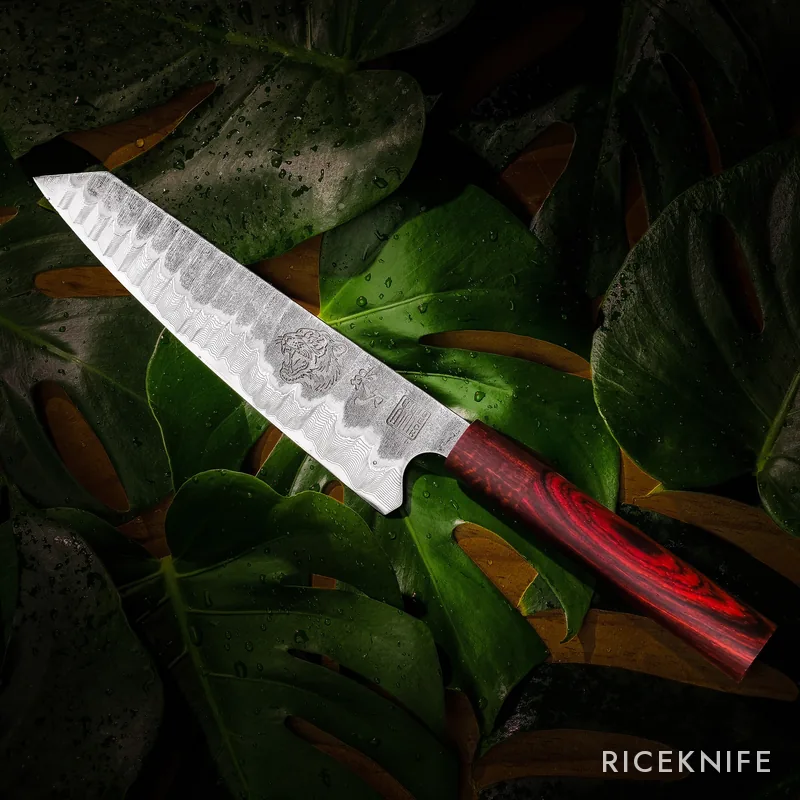
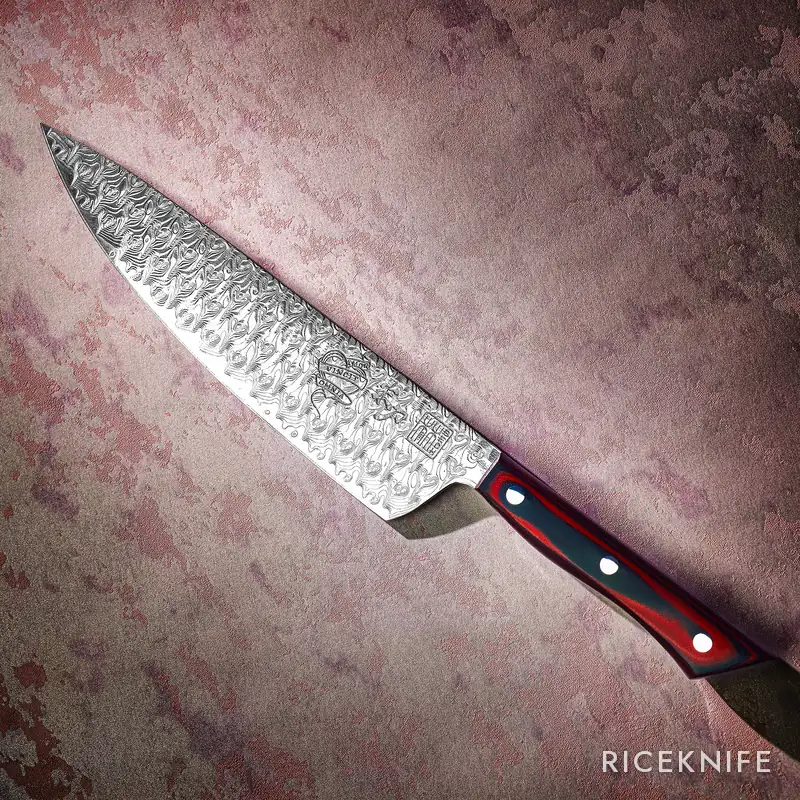
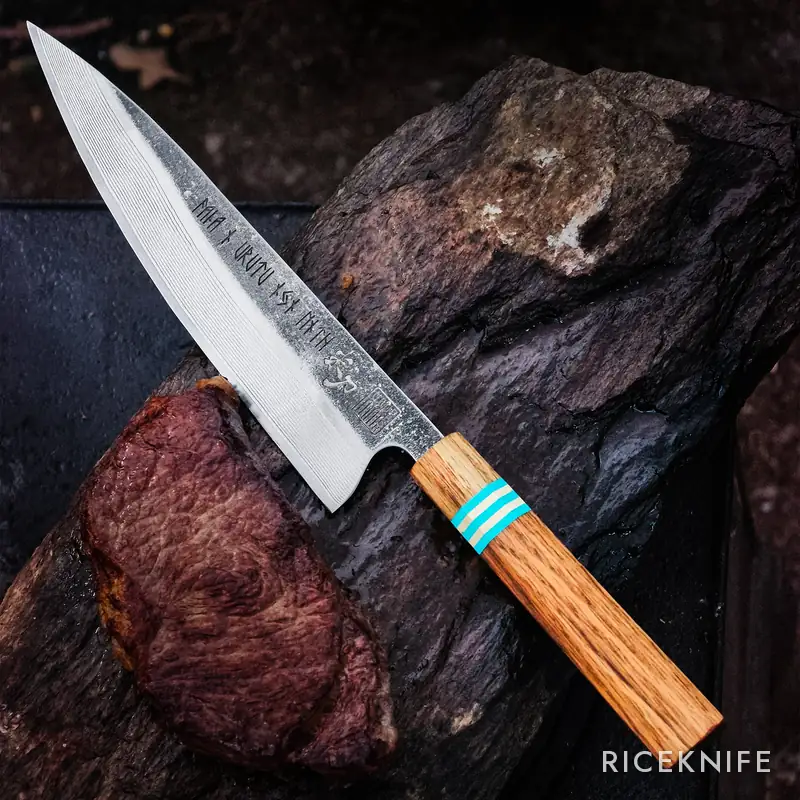
| Knife | Type | Blade length | Blade height at heel | Net weight | Job, in the designers’ records |
|---|---|---|---|---|---|
| CARBON I | Utility knife | 15.0 cm | 30 mm | 105 g | Small, precise tasks alongside the chef’s knife |
| YOLO III | Santoku with K-tip | 16.8 cm | 54 mm | 183 g | Short, precise cuts and fine work with the K-tip |
| SHARK II | Chinese cleaver | 17.2 cm | 68 mm | 309 g | Vegetables, fish and boneless meat; the wide blade lifts cut ingredients |
| TIGRITUDE III | Kiritsuke chef’s knife | 20.8 cm | 53 mm | 185 g | Long cuts and precise work with the angled tip |
| AMOR II | Chef’s knife | 23.0 cm | 49 mm | 242 g | Long cuts and work that benefits from more weight behind the edge |
| VALKYRIE III | Gyuto chef’s knife | 23.7 cm | 54 mm | 204 g | Long, controlled cuts with the longer, lighter chef’s knife |
Three things stand out
- IThe set is organised by cut, not by ingredient. In the records, two knives take small and short cuts (CARBON I, YOLO III), three take long cuts (TIGRITUDE III, AMOR II, VALKYRIE III), and SHARK II, with the tallest blade in the set at 68 mm, is the one described as able to lift cut ingredients. In practical terms, its tall blade suits chopping vegetables and can be used to transfer the cut ingredients to a pan.
- IIThe two chef’s knives have different jobs. AMOR II and VALKYRIE III are within 7 mm of each other in length, but AMOR II is 38 g heavier and is recorded for work that benefits from more weight behind the edge, while VALKYRIE III is recorded as the longer, lighter chef’s knife for controlled cuts. One cook can use both for different jobs; two cooks can work side by side.
- IIIThe set mixes two ways of making a blade. According to RICEKNIFE’s product records, YOLO III, TIGRITUDE III and SHARK II are hand-forged under a power hammer, while AMOR II, VALKYRIE III and CARBON I are not forged. All six share the same core steel, the same 316L cladding, the same layer count and the same hardness specification.
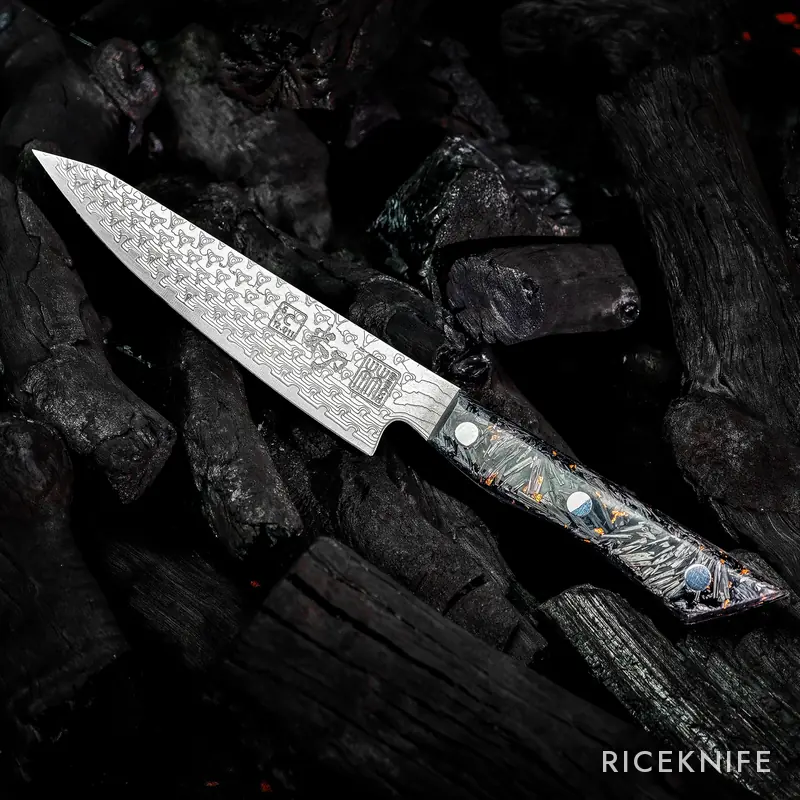
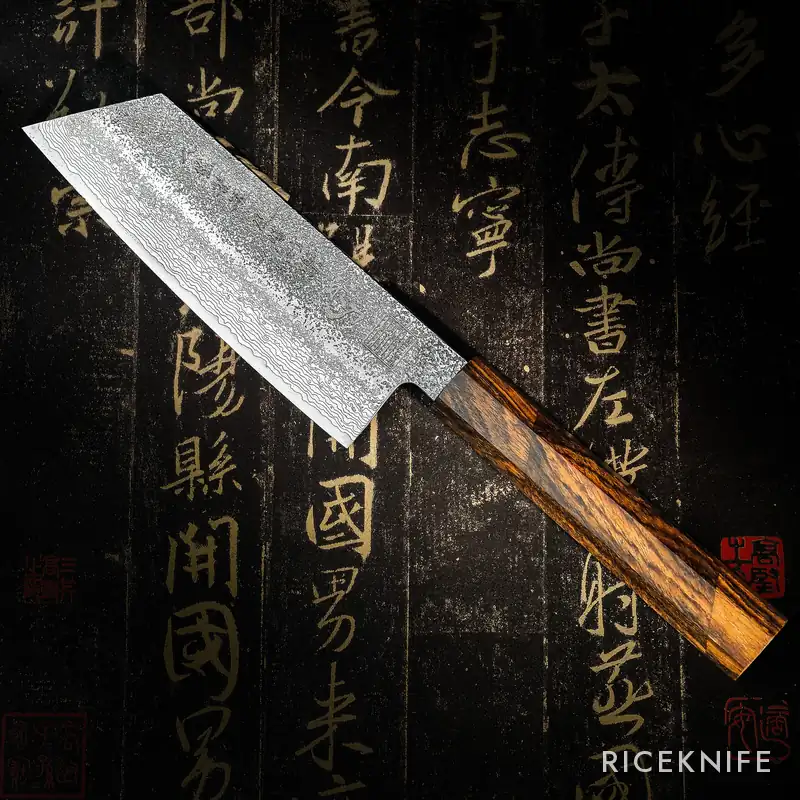
The records also state what the set leaves out: no bread knife and no knife stand. If a bread knife matters to you, RICEKNIFE’s owner names the RAW OAK six-knife set as the simpler, more affordable Scandinavian alternative; it includes TYR, a bread knife, in 9Cr18MoV stainless steel specified at 61 HRC.
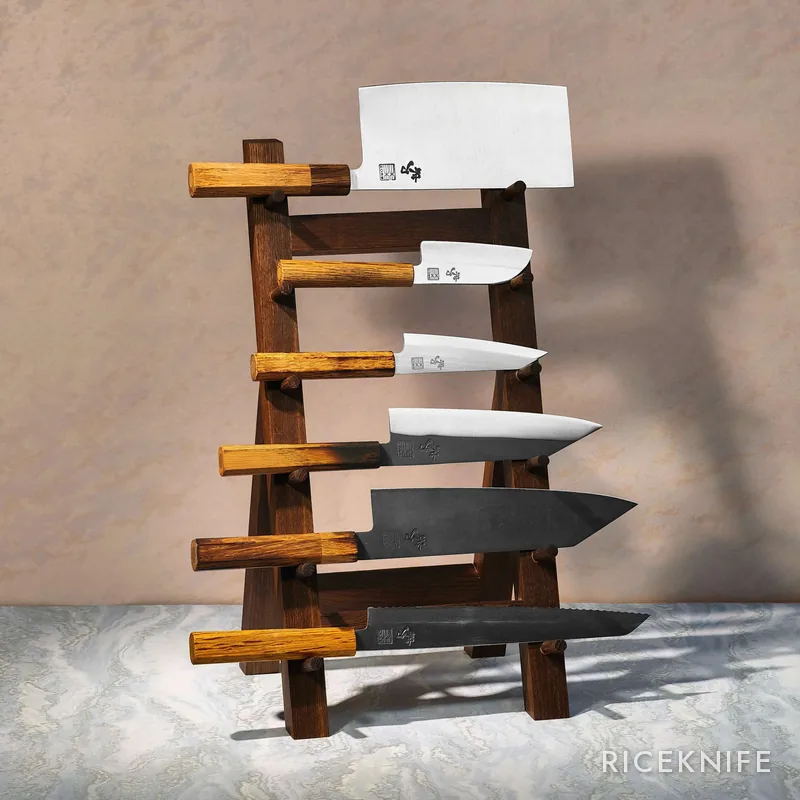
The RAW OAK six-knife set, which includes the TYR bread knife. The stand in the photo is sold separately.
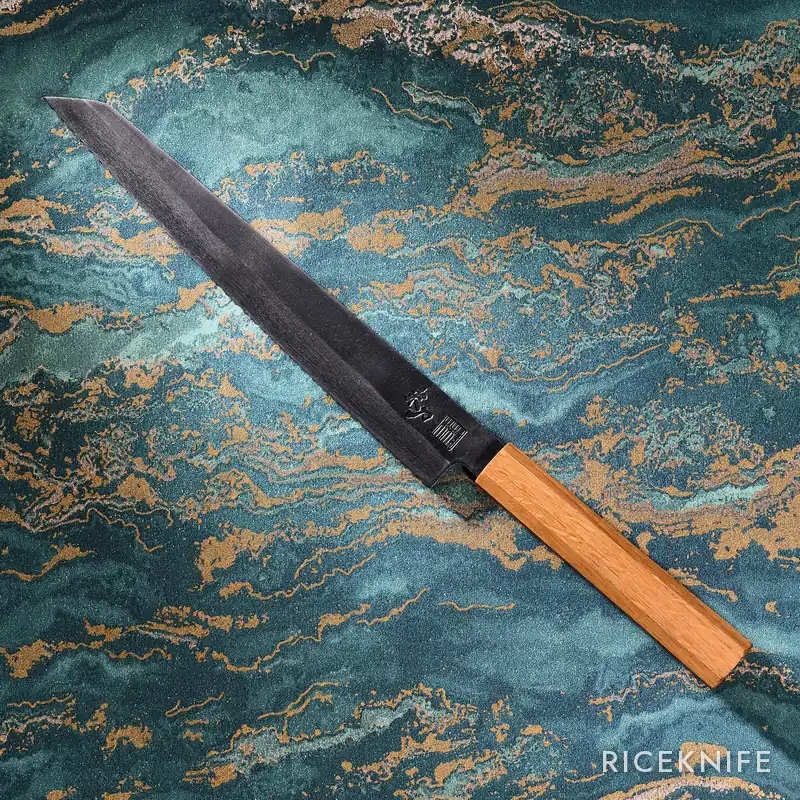
TYR, the bread knife in the RAW OAK set.
The designers describe EX-ANIMO as functional art and collectible design. EX-ANIMO means “from the soul”, and the knives carry their own stories: YOLO III’s Chinese inscription means that life is short and should be enjoyed, and VALKYRIE III carries the line “To fall in battle, not in dishonor.” Each EX-ANIMO III knife comes with a numbered RICEKNIFE certificate. The first release is 200 knives per design.
What blade height and edge angle change
Two pieces of geometry, worked through with the published heights and an idealised edge model.
A. Blade height
The heights at the heel run from 30 mm (CARBON I) to 68 mm (SHARK II), more than double. Height decides two practical things: how much room your knuckles have above the board when the edge is down, and how much cut food the side of the blade can carry. That is why the designers describe SHARK II as the knife whose wide blade lifts cut ingredients, and CARBON I as the small knife you use alongside the chef’s knife. These are geometric consequences of the published heights, not measured handling tests. How comfortable a knife feels still depends on your hand and grip.
B. Edge angle
For an idealised, symmetric V-shaped edge whose two straight faces meet at the apex, the thickness at distance d measured along the centreline from the apex is:
thickness = 2 × d × tan(α)
where α is the angle between either face and the centreline. In this idealised model, at 15° per side the edge is 0.54 mm thick 1 mm behind the apex, measured along the centreline. At 20° per side, it is 0.73 mm thick at the same point.
In this idealised geometry, the 20° edge is about 36% thicker 1 mm behind the apex. That describes thickness at one point, not cutting force, which also depends on the blade further back, the food and the cut. Geometrically, a thinner edge places less material behind the apex. This can reduce the wedge effect during cutting, but it can also leave less material to withstand local damage. Actual cutting force and damage resistance depend on the full blade geometry, the steel and the cutting conditions. These angles illustrate the principle; they are not measurements of EX-ANIMO III edges.
Set or single knives: a decision framework
Seven questions, in the order that settles the choice fastest.
- Which cuts do you make in a normal week? If you regularly make small precise cuts, long cuts and chop larger amounts of vegetables, the set covers all three. If you mostly do one kind, buy the knife for that job.
- Do you cook with someone else? The two chef’s knives let two people work at once. Cooking alone, decide whether you want weight behind the edge (AMOR II) or a longer, lighter blade (VALKYRIE III), or both for different jobs.
- Is most of your cutting vegetables? Start with YOLO III for fine work or SHARK II when there is a lot to chop.
- Do you need a bread knife? EX-ANIMO III has none. RAW OAK’s six-knife set includes TYR.
- Do you cut through bones or frozen food? None of these knives is made for that. Use a tool designed and sold for cutting bone.
- Where will the knives live? The six-slot oak knife stand is sold separately. Store the knives so the edges do not knock against other metal.
- Price: compare the set price with the sum of the single knives on the day you buy.
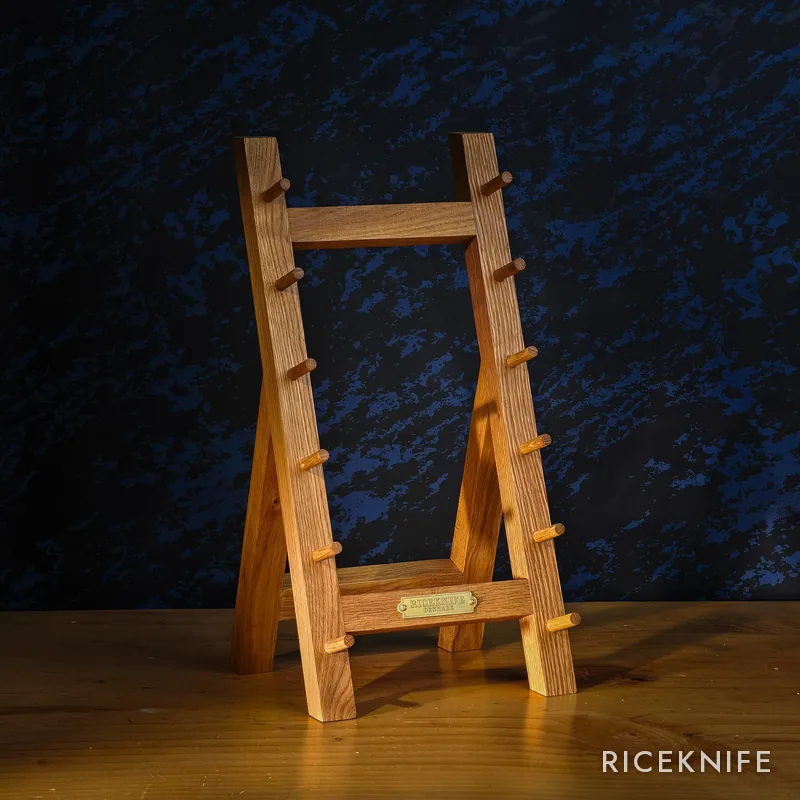
The six-slot oak knife stand, sold separately.
Want to see each knife up close? Every name in this article links to its product page, and the EX-ANIMO III set page shows all six together.
What we cannot tell you yet
Where no measurement exists, we say so instead of guessing.
- Edge angle
- We do not publish an edge-angle figure for EX-ANIMO III here.
- Sharpness and edge retention
- ISO 8442-5 defines a laboratory method that cuts synthetic test medium with forward and reverse strokes under controlled conditions [6]. We have not published ISO 8442-5 results for these knives, so this article makes no claim about how long they stay sharp.
- Toughness of the clad blade
- Not measured for these knives.
Questions buyers ask
Is a Damascus knife better than a plain steel knife?
The pattern alone does not establish cutting performance. Cutting depends on the core steel, its heat treatment, the edge geometry and the blade’s overall design. The cladding contributes to the blade’s appearance and determines the material exposed on its broad faces. Whether that improves corrosion resistance in a finished knife depends on the materials and construction and cannot be read from the pattern.
Why does the EX-ANIMO III set have two chef’s knives?
They do different jobs. AMOR II is heavier, for work that benefits from weight behind the edge. VALKYRIE III is longer and lighter, for controlled long cuts.
Is a Chinese cleaver a meat cleaver?
Not necessarily. “Chinese cleaver” covers both thin, tall knives for slicing and chopping food, often called Chinese chef’s knives or vegetable cleavers, and heavier cleavers made for bone. SHARK II is the thin kind: vegetables, fish and boneless meat, never bones or frozen food.
Is a bread knife or knife stand included?
No. The stand is sold separately, and RAW OAK’s six-knife set includes a bread knife.
How to read the evidence in this article
- Published research
- The two kinds of Damascus [1]; hardness, blade angle and edge tipping [4]; crack arrest in steel laminates [5].
- Author’s published view
- Jacob Bech, “Er Damascus knive gode?”, riceknife.dk, 8 November 2024: the pattern is first and foremost cosmetic.
- Standards and datasheets
- Clad construction [2], VG10 [3], ISO 8442-5 [6], 316L [7].
- RICEKNIFE records
- Owner-confirmed, not laboratory reports: 62.5 HRC, 73 layers, VG10 core, 316L cladding, knife types, blade lengths, heights, net weights, each knife’s job, the forging split, the use restriction, the omitted bread knife and stand, the RAW OAK alternative, the inscriptions, certificates and first-release quantity. Recorded in RICEKNIFE’s Brand OS and product data of 20 October 2026.
- Reasoned inference
- Why the bone and frozen-food rule follows from hardness and edge geometry; what blade height means for knuckle room and carrying food.
- Open questions
- Edge angle, ISO 8442-5 results and blade toughness for these knives.
Sources
- Verhoeven, J.D., Pendray, A.H. and Dauksch, W.E. (1998). The Key Role of Impurities in Ancient Damascus Steel Blades. JOM 50(9), 58–64. tms.org. Supports (Introduction and “Damascus steel” section): the two types of Damascus steel; pattern-welding of high- and low-carbon sheets; wootz at about 1.5% carbon with patterns from bands of cementite particles. Full text read 23 October 2026.
- Takefu Special Steel Co., Ltd. Clad metal. e-tokko.com. Supports (“Multi-layer” entry): metals clad alternately in repeated layers giving a Damascus pattern. Read 23 October 2026.
- Takefu Special Steel Co., Ltd. VG10. e-tokko.com. Supports (composition table and text): VG10 representative composition, hardness of HRC 60 or more, role of the alloying elements. Read 23 October 2026.
- Zhang, Q., Liu, F., Wu, D., Qu, S., Liu, W. and Chen, Z. (2023). A Comprehensive Understanding of Knife Cutting: Effects of Hardness, Blade Angle and the Micro-Geometry of Blade Edge on the Cutting Performance. Materials 16(15), 5375. doi.org/10.3390/ma16155375. Full text: PMC10420138. Supports: the authors’ CATRA cutting tests on seven martensitic steels, their measured hardness range of 53.2–62.4 HRC (Table 3), their discussion of hardness and cutting depth, and their findings on blade angle and edge damage. These are not performance tests of EX-ANIMO III. Full text read 23 October 2026.
- Kasberger, R. (2018). Steel laminates with highly improved fracture toughness. Doctoral thesis, Montanuniversität Leoben. pure.unileoben.ac.at. Supports (abstract): crack arrest by ductile interlayers. Abstract read 23 October 2026.
- ISO 8442-5:2004. Materials and articles in contact with foodstuffs. Cutlery and table holloware. Part 5: Specification for sharpness and edge retention test of cutlery. iso.org. Supports (official abstract): scope and principle of the test. Official abstract read 23 October 2026.
- Aperam. 316L (EN 1.4404) product page. aperam.com. Supports (“Main features” and “Chemical composition, typical values”): 316L typical composition and corrosion resistance. Read 23 October 2026.