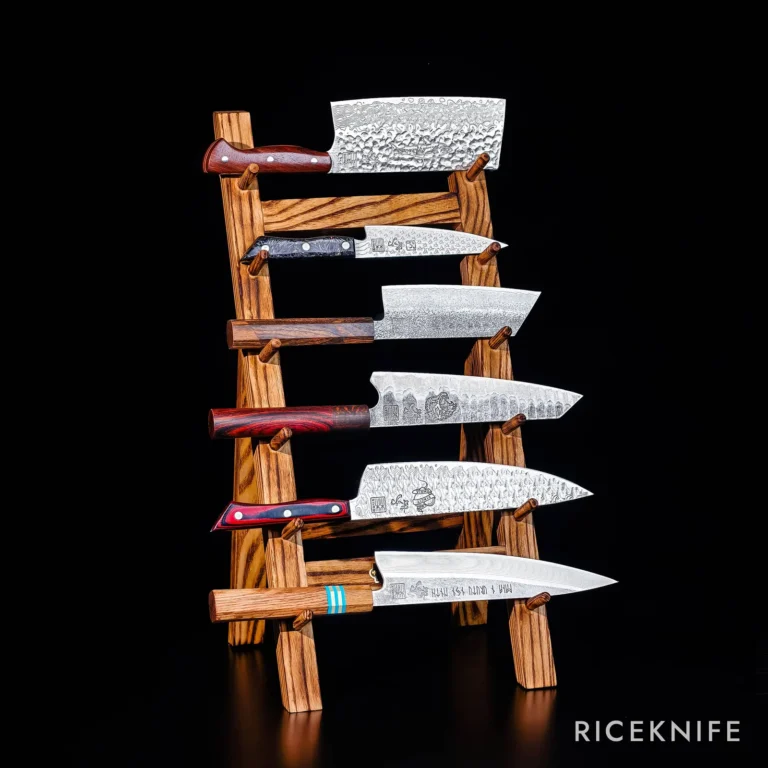
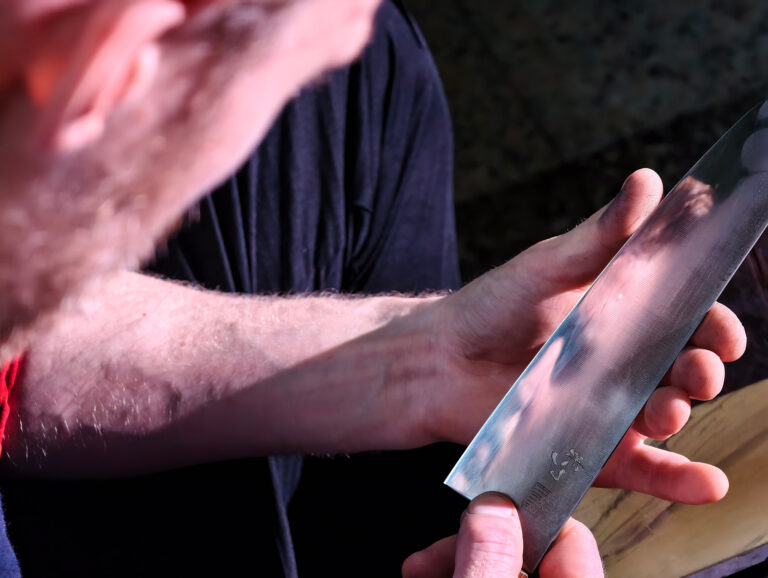
Knives have been my passion since I was a kid—now I design, forge, and sell them at Riceknife.
And here’s the biggest myth I want to bust:
Damascus steel doesn’t make your knife sharper.
Those mesmerizing wavy patterns? Stunning, but not magic. They won’t slice your tomatoes thinner than a well-crafted mono-steel blade.
So, why choose Damascus? Because it’s more than a tool—it’s a work of art that makes every cut feel special.
What Is Modern Damascus Steel?
Forget the ancient legends of Persian Wootz steel, forged in crucibles and lost to time.
Today’s Damascus is pattern-welded steel—layers of different alloys forged, folded, and etched to create hypnotic patterns. It’s craftsmanship you can see and feel.
But here’s the deal: the pattern is just the surface. The real work happens in the blade’s core—the steel that does the cutting.
For an in-depth look at historical steel processes, see Verhoeven, J.D. (2001). “Damascus Steel: Myth and Reality,” Metallography, Microstructure, and Analysis, ASM International.
Why Choose Damascus?
Let’s be real: Damascus knives turn heads. A raindrop or ladder pattern can stop a dinner guest mid-bite.
It’s not about sharpness—it’s about soul. At Riceknife, we craft Damascus blades because they tell a story of fire, skill, and beauty.
Plus, there’s a practical side. Layered steel—called cladding—protects a hard, high-carbon core, blending sharpness with durability. It’s like armor for your blade.
What Really Makes a Knife Perform?
Three things matter most:
- Core Steel: High-carbon steel with elements like vanadium or molybdenum defines your edge potential.
- Heat Treatment: The magic step that locks in strength, hardness, and edge retention.
- Edge Geometry: A thin, precise edge cuts better than a thick one—no matter the steel.
The Damascus pattern? Pure aesthetics—just the kind that stops people mid-sentence.
What to check when buying a Damascus knife
- Which steel or steels form the cutting edge? A Damascus pattern alone does not establish cutting performance.
- Is the hardness given in HRC, and who measured it?
- If the blade has cladding, what is it made of? Stainless cladding does not make an exposed carbon-steel core stainless.
- Does the seller show proof of the steel, such as a mill certificate?
- Is the care advice clear, including washing, drying and rust prevention?
Our EX-ANIMO III knives have 73-layer Damascus blades with a cobalt-bearing VG10 core at 62.5 HRC and 316L stainless outer layers. The product page includes the mill certificate for the VG10 steel. See how EX-ANIMO III documents its steel
Wootz vs. Modern Damascus
Ancient Wootz was a marvel, with carbon structures that made it tough and sharp.
Modern Damascus is different—built for precision with layered alloys.
We control every property, from edge retention to corrosion resistance, to create blades that perform as good as they look.
For scholarly insight into crucible steel technologies, refer to Feuerbach, A.M. (2002). “Crucible Steel in Central Asia: Production, Use, and Origins,” in Technological Innovation and the Spread of Materials, Archaeopress.
Quick FAQs for Knife Lovers
Does Damascus steel make a knife sharper?
No. Sharpness depends on the core steel, heat treatment, and edge shape.
Is Damascus stronger?
It can be. Cladding adds resilience, but a top-tier mono-steel blade can match it.
How do I care for a Damascus knife?
Hand wash, dry immediately, and avoid dishwashers. Oil carbon steel or wooden handles for longevity. See our Knife Care Guide.
Is modern Damascus like ancient Wootz?
Nope. Wootz was crucible-forged; modern Damascus is pattern-welded. Same vibe, different tech.
The Riceknife Difference
At Riceknife, we don’t just chase pretty patterns.
Our blades combine premium core steels with unique Damascus designs—raindrop, twist, or ladder—for a balance of performance and artistry.
Every knife is a testament to our obsession with quality.
Ready to elevate your kitchen game?
Explore Our Damascus Collection and find a blade that’s as bold as you are.
— Jacob Bech, Founder & Knife Maker